

How I Used the EHR 12-Block™ to Build a Better Stress-at-Work Risk Assessment
This month, I’ve been supporting one of our teams through a Risk Assessment consultation, helping them build a structured Stress at Work Risk Assessment.
For this week’s Leadership Journal, I want to take you through that process — using just one line as the example.
Because this is where the Energy to Harm Resilience (EHR) Model™ really earns its place:
It turns complex, people-based challenges into clear, traceable systems of energy, events, exposure, and harm.
The Example: Poorly Communicated Change
During the consultation, I used the EHR 12-Block™ myself to analyse one of the team’s problem statements — Poorly Communicated Change.
By running it through the model, I could translate what initially sounded like a “soft” issue into a full risk-assessment line — complete with hazards, barriers, and resilience layers.
Energy → Event → Exposure → Harm.
How I Did It – Step by Step
1. Start with the problem statement
I took the written issue — “Poorly Communicated Change” — exactly as it appeared in the workshop notes. No editing, no assumptions.
2. Map the Energy
Ask: “What energy is driving this problem?”
In this case, it was human and organisational energy — the way decisions, timing, and communication flow through the business.
3. Identify the Event
Ask: “What happens when that energy misfires?”
Employees hear about change through rumours or informal channels before leadership communicates it, creating uncertainty.
4. Locate the Exposure
Ask: “Who or what experiences the consequence?”
Teams are repeatedly exposed to incomplete or conflicting information.
5. Define the Harm
Ask: “What’s the real impact?”
Anxiety, confusion, and loss of trust in leadership.
6. Map the Barriers and Resilience Controls
At this point, I mapped both the energy barriers and the resilience controls that sustain each one.
This step is critical: barriers can fail if resilience isn’t designed in from the start.
For example:
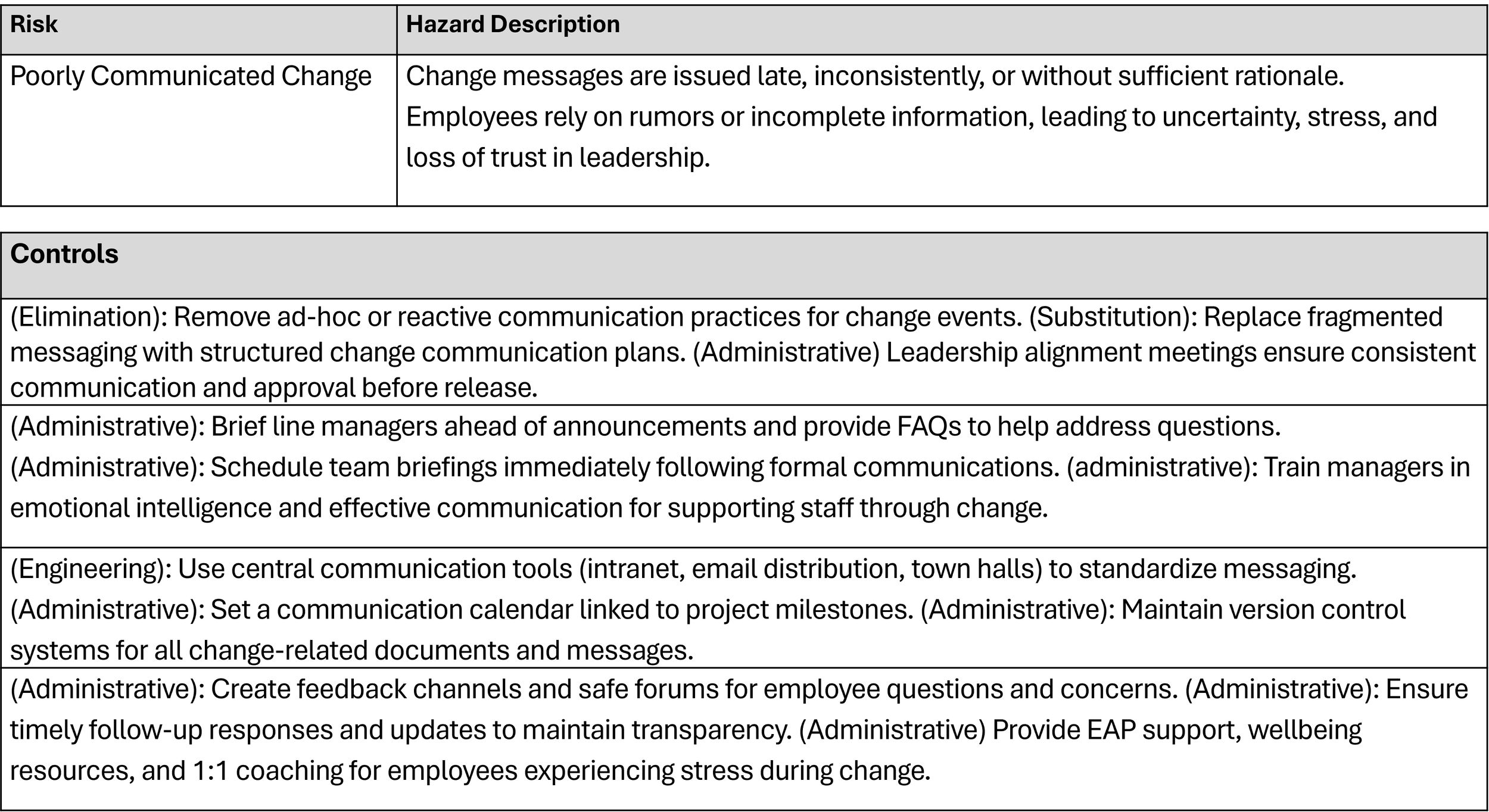
Energy Barriers – Eliminate ad-hoc communication and substitute structured change plans.
Event Barriers – Standardise messaging through town-halls and intranet posts.
Exposure Barriers – Ensure line managers are briefed early to cascade consistent messages.
Harm Barriers – Maintain open feedback channels and Q&A sessions.
Then I identified what kept each barrier alive over time:
Leadership alignment meetings (resilience for energy barriers).
Version control and communication calendars (resilience for event barriers).
Manager training and wellbeing resources (resilience for exposure and harm barriers).
By doing this, I could see which layers were elimination or substitution, and which were administrative controls sustained by resilience systems.

Picture 1: 12-Block: Poorly Communicated Change
7. Translate into the Risk Assessment
Each barrier–resilience pair became a single, testable control line in the Stress at Work Risk Assessment — linked to ownership, verification, and review frequency.
By the end, that single statement became a complete, auditable risk line with visible controls at every stage of the energy chain.
Picture 2: Risk Assessment example with layers on controls
What the 12-Block Revealed
Energy: Human and organisational actions that delay or distort communication.
Event: Teams hear change news through rumours instead of leadership.
Exposure: People operate with incomplete or conflicting information.
Harm: Anxiety, stress, and loss of confidence in leadership.
The Takeaway
The EHR 12-Block™ turns discussion into design.
It helps leaders identify where energy escapes — even in human systems — and build barriers strong enough to withstand it.
That’s what Luck to Leadership – The Energy to Harm Resilience (EHR) Model™ is all about:
Helping leaders see energy before harm — whether that energy is mechanical, electrical, or human.
Reflection Questions
Which of your “soft” risks could you map through Energy → Event → Exposure → Harm?
Does your current risk assessment reveal control gaps, or merely document them?
How do you verify that your barriers still hold months later?
The EHR 12-Block™ and full Energy to Harm Resilience Model™ are detailed in
Luck to Leadership – The Energy to Harm Resilience (EHR) Model™,
available now at energytoharmresilience.com and on Amazon worldwide.